
Washington’s next moves in the South Caucasus
Six months after Armenia and Azerbaijan signed a U.S.-brokered peace declaration in Washington, Vice President J.D. Vance’s early-February trip to both countries underscored Washington’s determination to lock in the deal. Agha Bayramov, assistant professor at the Department of International Relations at the University of Groningen and co-founder of The Hague Research Institute, explores what deeper U.S. engagement would mean for the South Caucasus’s shifting geopolitical landscape.
 The Armenian Prime Minister Nikol Pashinyan receives U.S. Vice President J.D. Vance during his visit to Yerevan on February 9, 2026. Photo: Website of The Prime Minister of the Republic of Armenia
Last month, Vice President J.D. Vance became the highest-ranking U.S. official ever to visit both Armenia and Azerbaijan. The visit signalled Washington’s strong commitment to the Trump Route for International Peace and Prosperity (TRIPP) – the major diplomatic milestone brokered by U.S. President Donald Trump last August at the White House, where he hosted the leaders of both countries to sign a joint declaration aimed at easing one of the longest-running conflicts in the South Caucasus.
Light at the end of the tunnel
TRIPP is a U.S.-backed plan to open a 43-kilometre corridor through Armenian territory connecting mainland Azerbaijan with its Nakhchivan exclave. Since the signing of the agreement, the region has witnessed the first tangible signs of renewed transit cooperation.
In November 2025, wheat shipments from Kazakhstan and Russia reached Armenia via Azerbaijan for the first time in nearly three decades, signalling the practical reopening of regional corridors. In December 2025, Azerbaijan delivered an initial batch of fuel to Armenia via Georgia. In February 2026, another grain shipment arrived in Armenia through Azerbaijan.
These early movements – modest in scale but symbolically significant – demonstrate that the commitments linked to TRIPP are beginning to bear fruit. For Armenia and Azerbaijan, they represent initial confidence-building steps; for external partners, they offer an early indication that the regional environment is shifting from conflict management toward cautious re-engagement.
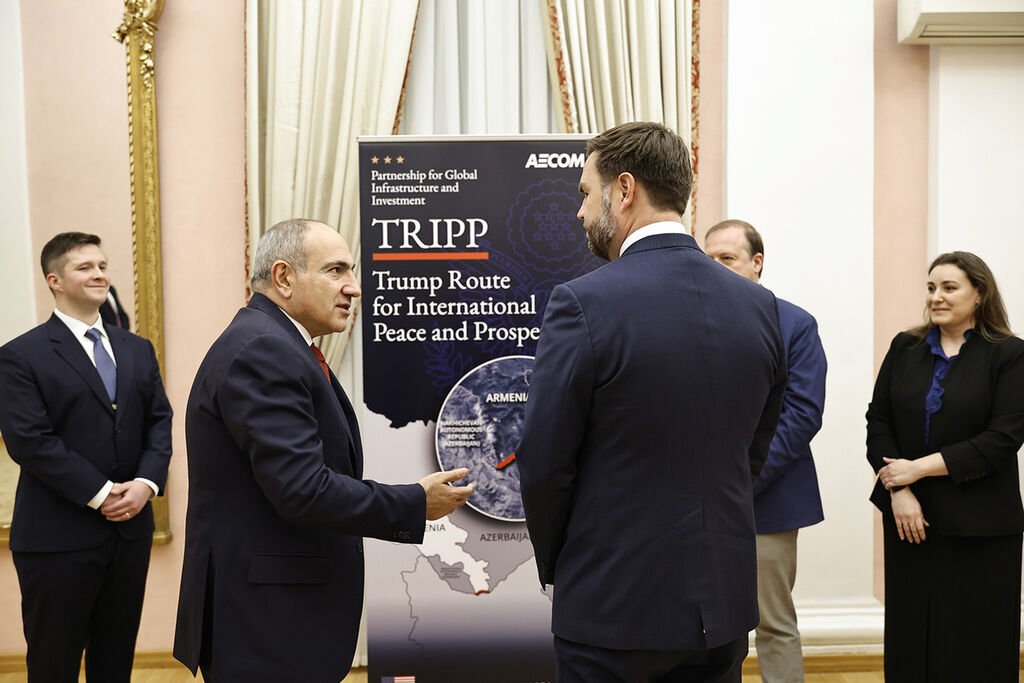 Armenian Prime Minister Nikol Pashinyan and U.S. Vice President J.D. Vance discuss the Trump Route for International Peace and Prosperity during Vance’s visit to Yerevan on February 9, 2026. Photo: Website of The Prime Minister of the Republic of Armenia
Armenia: from Russian to American nuclear technology?
During his visit to Yerevan, Vance oversaw the conclusion of a civil nuclear cooperation agreement with Armenia, enabling the U.S. to license exports of nuclear technology and equipment to help replace the country’s ageing nuclear power plant.
According to Vance, the deal could generate up to $5 billion in initial U.S. exports, with an additional $4 billion in long-term fuel supply and maintenance contracts. While the agreement is unlikely to immediately displace Russian involvement at the plant, it lays the foundation for a future reactor independent of Rosatom and for the gradual diversification of Armenia’s nuclear fuel supply.
The timing and substance of Vance’s visit can be read as a signal of U.S. political support for Armenian Prime Minister Nikol Pashinyan ahead of parliamentary elections in Armenia in June. Washington is not only deepening its strategic cooperation with Armenia but also demonstrating a visible stake in the country’s stability and political trajectory.
Azerbaijan eager to play a bigger role
The following day, in Azerbaijan, Vance signed a strategic partnership agreement, further expanding U.S. engagement in the South Caucasus and signalling that it seeks to balance relations with Armenia and Azerbaijan. The agreement covers cooperation in the fields of security, technology, economy and connectivity. Among other things, the U.S. will assist with de-mining.
Since Azerbaijan’s oil production is declining and gas production is not increasing significantly, expanded connectivity would likely enhance Azerbaijan’s strategic role as an indispensable transit state between Europe and Asia.
That would strengthen Azerbaijan’s strategic autonomy by deepening interdependence with the EU, China, Türkiye, the Central Asian states, and others. Baku would also benefit from greater diplomatic leverage in regional and external negotiations. From this perspective, transport corridors function as a form of ‘soft security guarantees’ – the more critical Azerbaijan becomes to regional trade, the higher the political cost for external actors to ignore its interests.
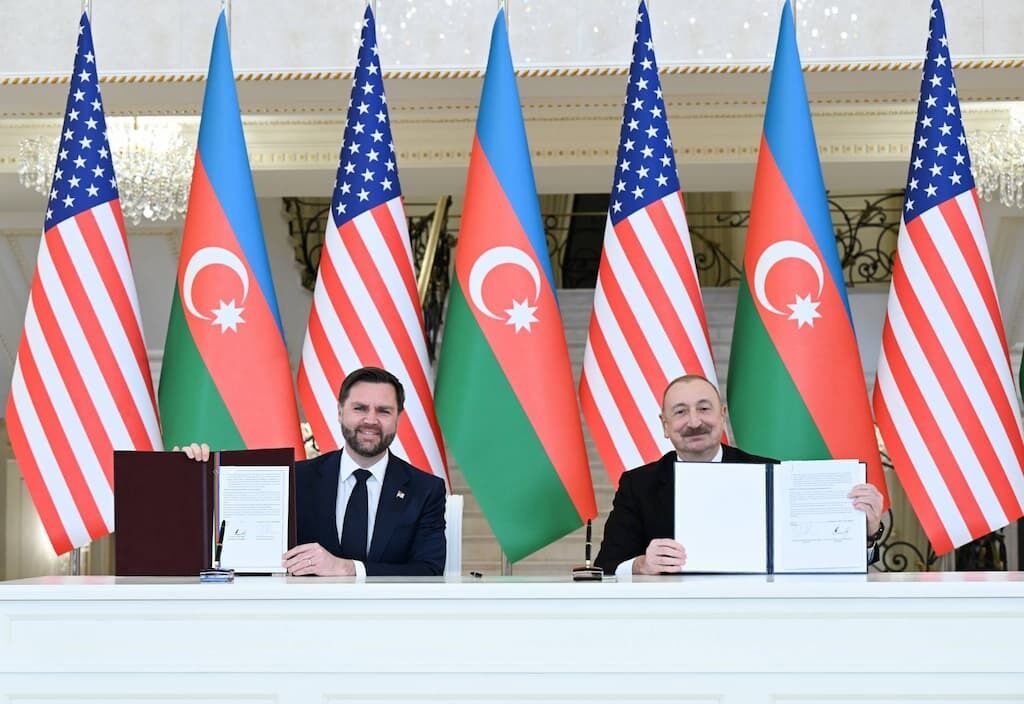 U.S. Vice President J.D. Vance and Azerbaijani President Ilham Aliyev sign a strategic partnership agreement between their countries in Baku on February 10, 2026. Photo: Official website of the President of the Republic of Azerbaijan
More than a battlefield
The broad U.S. interest in the South Caucasus points to a clear paradigm shift in the region. For three decades, external engagement was characterised by conflict management. The ‘Karabakh prism’ defined diplomatic priorities, and virtually every foreign initiative was assessed through the lens of escalation risk and ceasefire stability.
Security considerations overshadowed economic integration, and the region was treated primarily as a potential flashpoint. Today, that framework is being replaced. External actors increasingly approach the South Caucasus as a strategic corridor—focused on transport routes, energy diversification, digital infrastructure, and trade flows—rather than as a battlefield requiring constant crisis management.
U.S. interest in the region carries significant potential to shift relations from zero-sum to positive-sum dynamics. Improved infrastructure and access could substantially reduce the cost and duration of trade routes, benefiting all parties involved—particularly Armenia.
U.S. interest in the region carries significant potential to shift relations from zero-sum to positive-sum dynamics
Re-establishing overland transit would mean reopening the country’s borders with Azerbaijan and marking a decisive step toward ending Armenia’s current state of geopolitical isolation. Although Türkiye–Armenia relations fall outside the scope of the TRIPP, progress on Armenia–Azerbaijan normalisation could, over time and if Ankara and Yerevan see mutual benefit, stimulate additional regional openings.
Iran and Russia losing influence?
The momentum generated by U.S. involvement in the South Caucasus has triggered concern among the regional powers, Russia and Iran. In an interview with TASS, Russian Deputy Foreign Minister Mikhail Galuzin argued that ‘the West is using Armenia as a tool in the geopolitical struggle in its confrontation with Moscow,’ framing Armenia’s recent diplomatic shifts as part of a broader Western containment strategy.
At the same time, relations between Baku and Moscow remain strained. Speaking at the Munich Security Conference, Azerbaijani President Ilham Aliyev accused Russia of having ‘deliberately attacked’ the Azerbaijani embassy and its infrastructure in Ukraine, despite Baku having provided Moscow with the precise coordinates of its diplomatic missions.
The current tensions suggest that Russia’s ability to assert itself in the South Caucasus is increasingly constrained. With its military and economic resources heavily committed to the war in Ukraine, Moscow appears less capable of countering expanding U.S. engagement in the region. Whether this apparent passivity reflects a deliberate strategic retrenchment or signals a deeper and more lasting erosion of Russian influence remains an open question.
For Iran, meanwhile, developments along its northern frontier are a direct matter of national security. Iran sees TRIPP and broader normalisation between Armenia and Azerbaijan not merely as an infrastructure project but as a geopolitical development that could reshape the power balance in the South Caucasus to Iran’s disadvantage, for instance, by weakening its role as a transit state. As a consequence, they might try—through political pressure, economic leverage, or diplomatic manoeuvring—to slow down or complicate these initiatives.
 Azerbaijan’s President Ilham Aliyev, with U.S. Vice President J.D. Vance, stands as an Azerbaijani honour guard marches past, during an official welcome ceremony in Baku. Photo: ANP / EPA / AZERBAIJAN PRESIDENTIAL PRESS SERVICE HANDOUT
Where is the EU?
Vance’s visit shows that the South Caucasus has moved from the periphery to the forefront of U.S. foreign policy. Yet in Brussels, the region is often still treated as peripheral. For the European Union, the current moment presents both an opportunity and a strategic dilemma. As Washington reasserts its diplomatic and economic role, and as Moscow’s and Tehran’s influence potentially diminish, Brussels should decide how to position itself within this evolving regional order.
Vance’s visit shows that the South Caucasus has moved from the periphery to the forefront of U.S. foreign policy
TRIPP matters to the EU for economic and geopolitical reasons. Economically, it offers a chance to diversify Europe’s connections with the South Caucasus, Central Asia, and Asia more broadly. While existing transit routes operate through Georgia and Azerbaijan, strained EU-Georgia relations make it essential for Brussels to open an additional route – this time via Armenia to Azerbaijan.
Geopolitically, the corridor would strengthen the EU’s presence as a credible political actor in the region and support its goal of deepening ties with both Armenia and Azerbaijan. In this regard, clearing landmines is vital to unlocking the region’s economic potential and securing the TRIPP corridor. Some local policymakers argue that if Brussels seeks to position itself as a credible actor in the South Caucasus, it should ensure that the economic dividends of peace are distributed equitably and visibly across the region, including through meaningful financial participation in the rebuilding and development of Karabakh and adjacent infrastructure corridors.
Brussels does not need to compete with Washington’s leadership, but it should avoid policy stagnation. Given the U.S.’s tendency to prioritise short-term results and its uncertain long-term commitment to the region, the EU’s comparative advantage lies in its patience, institutional continuity, and broad policy toolbox.

Vance skips Georgia
J.D. Vance’s February 2026 tour of the South Caucasus bypassed Georgia, widely interpreted as a telling sign of shifting regional dynamics. The Georgian government has sought to maintain its strategic standing with the U.S. administration by underscoring its readiness to reset relations. Prime Minister Irakli Kobakhidze stated that he aims ‘to renew the strategic partnership with the United States from a clean slate, with a well-defined roadmap.’
U.S. involvement in the South Caucasus signals that conflict is no longer the defining dynamic of external engagement. TRIPP and related initiatives could gradually integrate Armenia and Azerbaijan into overlapping networks of trade, energy, and infrastructure. This would raise the political cost of renewed confrontation, while rewarding cooperation with significant economic gains.
Yet this outcome is not predetermined. Russia and Iran are unlikely to passively accept a diminished role, and their capacity to disrupt or delay projects remains real. Much will therefore depend on whether the U.S. and the EU sustain coordinated involvement beyond symbolic diplomacy and commit to long-term investment and institutional presence.